How a Car's Braking System Works
A car’s braking system is one of its most important safety features. Every time you slow down for traffic, stop at a junction, or park on a hill, you’re relying on a carefully designed system that turns motion into stopping power. While modern brakes use advanced technology, the basic principles are surprisingly simple. Let’s break down how a car’s braking system works, step by step.
The Purpose of the Braking System
At its core, the braking system is designed to:
- Slow the car down
- Bring the car to a complete stop
- Hold the car stationary when parked
It does this by converting the car’s kinetic energy (movement) into heat energy through friction.
The Main Components of a Car's Brake System
Most cars use a hydraulic braking system made up of several key components:
- Brake pedal
- Brake Booster (SERVO)
- Master Cylinder
- Brake Lines and hoses
- Brake Discs / Drums / Brake Pads
- Hand Brake System
Each component plays a role in transferring your foot pressure into braking force at the wheels.
What Happens When You Press the Brake Pedal?
When you press the brake pedal, a chain reaction begins:
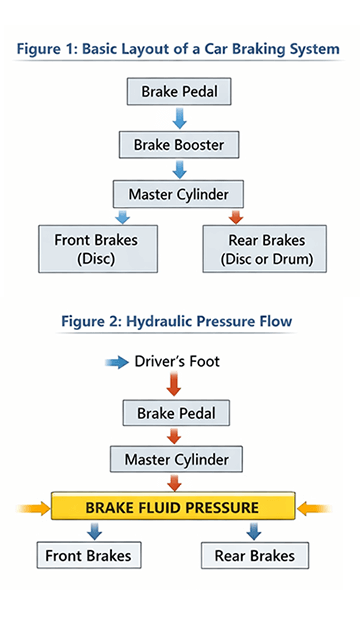
Your foot applies force to the brake pedal. This force is multiplied by the brake booster (also called a servo), which uses engine vacuum (Vac Pump) or an electric pump to reduce the effort needed to brake.
This is why modern cars don’t require much pedal pressure to stop.
The boosted force pushes a piston inside the master cylinder. This converts mechanical force into hydraulic pressure.
The master cylinder is usually part of a dual-circuit system, meaning the brakes are split into two separate hydraulic circuits. If one circuit fails, the other can still provide partial braking — a critical safety feature.
The hydraulic pressure travels through brake fluid inside sealed brake lines. Brake fluid doesn’t compress, which makes it ideal for transmitting force evenly and instantly to all wheels.
This is the heart of the hydraulic braking system.
Disc Brakes: How Most Cars Stop
Most modern cars use brake discs, especially on the front wheels.
Brake Disc Components
- Brake Disc
- Brake Caliper
- Brake Pads
How Brake Discs Work
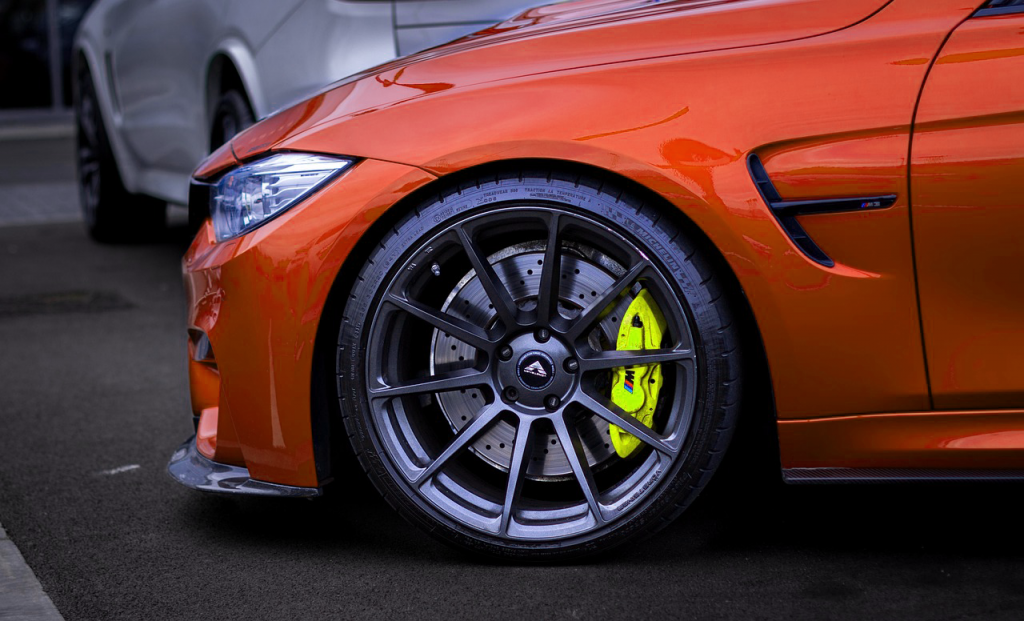
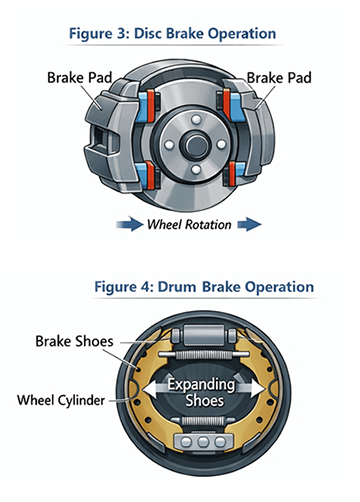
As hydraulic pressure reaches the brake caliper, pistons inside the caliper push the brake pads against both sides of the rotating brake disc. The friction between the pads and disc slows the wheel, and eventually the car, to a stop.
Disc brakes are very effective at handling heat and provide strong, consistent braking, which is why they’re used on the front wheels where most braking force is needed.
Drum Brakes: Still common on rear wheels
Some cars, especially smaller or budget models, use drum brakes on the rear wheels.
Drum Brake Components
- Brake Drum
- Brake Shoes
- Wheel Cylinder
- Return Springs
How Drum Brakes Work
Hydraulic pressure pushes pistons inside the wheel cylinder, forcing the brake shoes outward against the inside of the drum. The friction slows the wheel down.
Drum brakes are cheaper and last a long time, but they don’t cool as well as disc brakes.
The Parking Brake
The parking brake (handbrake or electronic parking brake) is a separate system used to hold the vehicle stationary. Unlike the main brakes, it usually works mechanically using cables, even in cars with hydraulic service brakes.
Electronic parking brakes use motors instead of cables, but they still serve the same purpose: keeping the car from rolling when parked.
Electronic Brake System Components
Many vehicles also include:
- ABS (Anti-Lock Braking System) – which prevents the wheels from locking up
- ESC (Electronic Stability Control) – uses the brakes to help prevent skidding or loss of control
These systems work automatically in the background to improve safety.
Heat, Wear and Maintenance
Because braking relies on friction, brake components naturally wear out over time. Brake pads, discs, and fluid all require regular inspection and replacement to ensure safe operation.
Overheating brakes can reduce effectiveness, a problem known as brake fade, which is why good ventilation and quality materials are important.
A car’s braking system may seem complex, but it works on a straightforward principle: using hydraulic pressure and friction to slow and stop the vehicle safely. From the moment you press the brake pedal to the instant the wheels stop turning, every component plays a vital role.
Understanding how the braking system works not only builds basic automotive knowledge but also helps drivers appreciate the importance of brake maintenance and safe driving habits.
Other Components that are linked to the Brake System
- Clutch
- Vac Pump
- Brake Pedal Switch